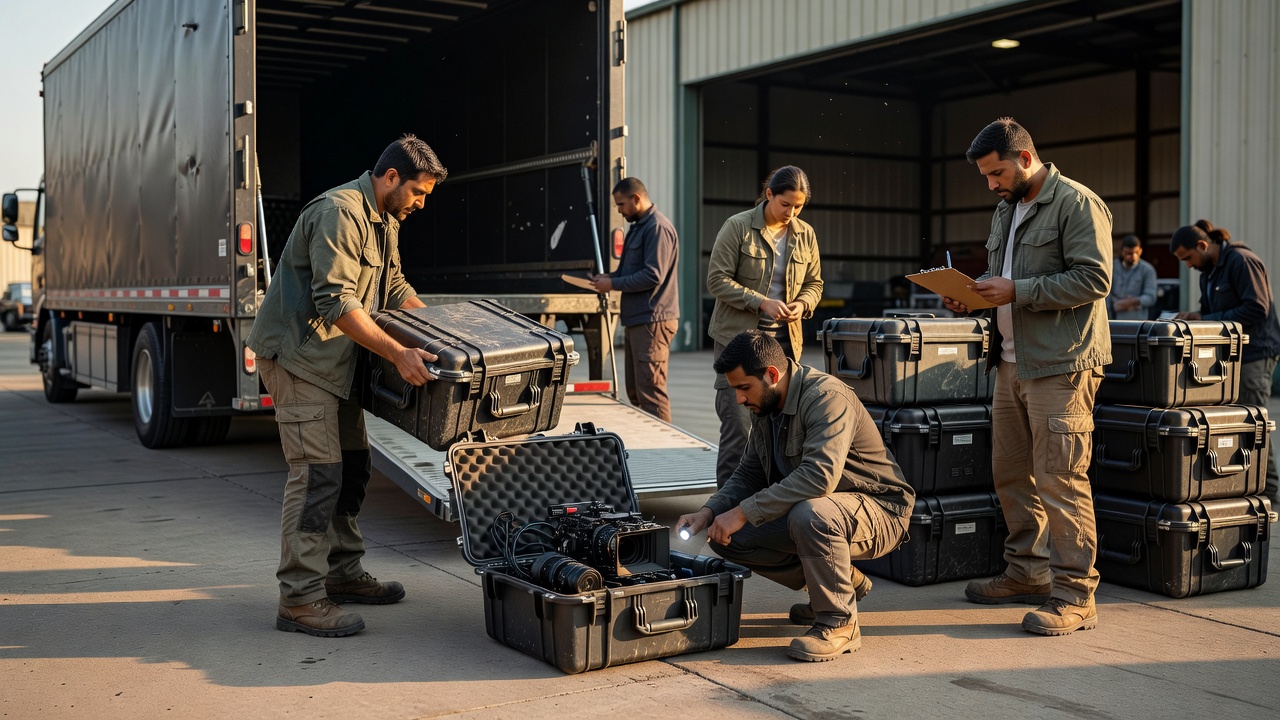
Start with the department’s working sequence
Ask what the department needs first, not simply what is ready to leave the rental house. A lighting team may require distribution equipment before fixtures. A camera team may need a build area and supporting accessories before a body can become operational. Transport should understand those dependencies without taking over the technical department’s decisions.
Translate the dependency into a delivery instruction: which load, which entrance, which receiver and which readiness target. Keep physical arrival separate from technical acceptance. A truck at the gate is not a completed delivery if nobody can open the store, operate the unloading equipment or check the cases against the manifest.
Make the manifest useful at both ends
A working manifest identifies packages clearly enough for loading and receiving teams to reconcile them. Use consistent case identifiers and department ownership. Where serial numbers are needed for rental, insurance or customs purposes, maintain the authoritative record in the production’s approved system rather than scattering copies through casual messages.
Record relevant dimensions and weights using confirmed information. Volume can prevent a load from fitting even when the weight is acceptable; payload can be exceeded even when there is visible floor space. Tail lifts, shelving, crew and other carried items affect the available capacity. The operator and competent loading team should assess vehicle suitability, load distribution and securing arrangements.
Keep unloading order compatible with safe loading
“Last on, first off” is a useful question, not a universal loading rule. Safe distribution, restraint requirements, fragile equipment and access to securing points may determine the final arrangement. Resolve conflicts before loading begins. Never ask a driver to leave a load unsecured because the journey is short or because a department wants quicker access.
- Confirm the first-needed items.The receiving department sets the working priority.
- Check the vehicle and handling method.Verify dimensions, capacities and suitable equipment.
- Agree the safe load plan.Competent personnel determine restraint and distribution.
- Record exceptions.Identify missing, substituted or separately routed items before departure.
The European Commission’s cargo-securing guidance can help frame planning questions. EN 12195-1 is a relevant reference for load-restraint calculations within its scope, but naming a standard does not establish compliance. Use competent advice and the equipment manufacturer’s instructions for the specific load and restraint system.
Reserve an actual receiving window
Locations should confirm whether the vehicle can approach, stop and unload at the intended time. A shared loading bay may also serve catering, construction or the property’s normal deliveries. Agree who controls the window and what happens if the previous movement overruns. A vague instruction to “arrive early” can move congestion outside the gate without improving readiness.
Assess the path after unloading. Door widths, lifts, stairs, uneven ground and public footways can change the handling plan. The receiving department should know what assistance and equipment are available. Do not assume that the driver is contracted or trained to perform every handling task. Clarify responsibilities with the operator and the site before dispatch.
Treat special loads as their own decision
Batteries, fuels, aerosols and other regulated articles can require more than an ordinary equipment manifest. ADR may apply to road movements of dangerous goods, depending on the goods and circumstances. Do not infer that a familiar production item is exempt. Ask the supplier and a competent dangerous-goods adviser where appropriate to establish classification, packaging, documentation and handling requirements.
Cross-border work adds another handoff. Temporary admission procedures, customs declarations and ATA Carnets may be relevant depending on the route and goods. The International Chamber of Commerce provides information about the ATA Carnet system; the responsible customs professional should confirm suitability. A carnet does not replace every other permission or regulatory requirement.
Close the loop at returns
Return movements deserve the same ownership as deliveries. Confirm who reconciles the equipment, records damage, checks accessories and signs the receiving record. A vehicle arriving at a closed rental depot has not completed a useful return. Verify opening arrangements and authorised out-of-hours procedures before the final unit move.
If an item is missing, separate the transport fact from the technical investigation. Record which cases were loaded, where the vehicle stopped and who received them, without assigning blame prematurely. Share only the information needed for the investigation. A clear chain of handoffs makes it easier to locate an exception without creating a second, conflicting inventory.
The best equipment route is not necessarily the shortest. It is the route that respects safe loading, permitted access, department dependencies and a named receiver. That combination protects the working sequence when the wider shooting schedule starts to move.